After eight years living a life of opulence in San Francisco, we made a return trip to Guatemala the first week in April 2014. Traveling was Andy, my wife, Lucia my 14-year-old daughter, Lisa our friend who is traveling for research work and myself. From San Francisco there are no direct flights, so we were routed through Dallas. A five-hour layover that turned into six, we ate a very poor meal at TGIF Fridays. Over-processed stuff. Chicken that tasted like rubber. Grilled vegetables that were cold and tasteless. You would think in the United States we could do better than this, but apparently not. In most airports food is either fast food or restaurants that are really sports bars, which serve over salted food, and who’s main objective is to tempt you with overpriced mass-produced cocktails.
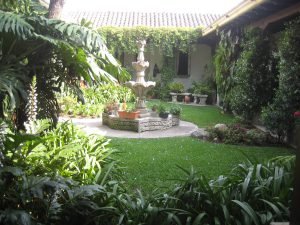
In Guatemala City, at the airport in the dark we caught a taxi to our Bed and Breakfast, a place we had stayed before. While it was close to the airport the taxi driver ended up roaming around a bit aimlessly. We entered gated neighborhoods with armed guards eventually exiting in confusion. After about 15 minutes, we got our bearings and found the place. It is not easy finding an urban dwelling surrounded by walls. The addresses are often cryptic and the order of streets is frequently unruly and illogical.
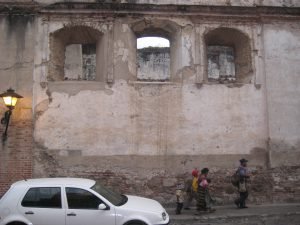
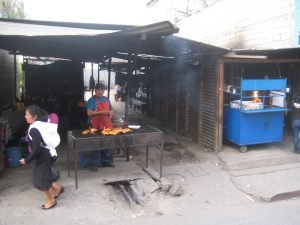
The next morning, at the bed and breakfast, after a homemade breakfast of papaya, eggs, beans and coffee, we rode to Xela in a private van with many empty seats. It is important to appreciate ample personal space when traveling in Guatemala, as often you can be crammed into the public chicken buses with three to a seat. Soon on the highway the experience begins to all fall into place. Lots of people walking on the side of the road – Mayan woman in their colorful garb carrying bundles on their heads, men in cowboy hats, kids on bikes patrolling the hood. Volcanoes soaring into the sky off in the distance. The brightly painted walls and signs for everything from hardware stores, to dentists, to political parties to the ubiquitous Tigo – the phone company. I vaguely remember each of the towns on this journey though the road seems a lot better now then it did in 2006. It is two lanes in both directions, which is new. Along the way we ate a roadside restaurant called Kape Paulinos where the food was excellent. The chicken was delicious and the freshly squeezed juices and handmade tortillas were superb.

We arrived in Xela around 3pm, found our hotel, got money from the ATM and chilled out for the rest of the day. After dark fell, we did go to a café that doubles as a museum. On one of the walls was a painting named Muerte de General Rufino Barrios. The date on the work was 1944 and I do not know if it was based on another painting, but I really became enthralled by the tragic scene. Rufino Barrios looms large in the history of Guatemala. In fact, the little town where I am writing this, San Lorenzo is the birthplace of Rufino. He was an enlightened fellow who became president of Guatemala and fought for the empowerment of the poor Mayans and Guatemala in general. He attempted to institute land reform, always a precarious topic for politicians, especially in Latin America. There is something about the painting of Rufino Barrios, dead on the battlefield that metaphorically tells a story that remains tragically the same today. Unlike, Peru or especially Bolivia, in Guatemala the indigenous peoples are pretty marginalized politically.
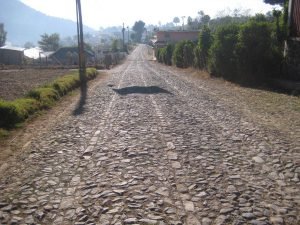
The next day at 6am we were picked up from our hotel by Eduardo, one of the longtime workers of health studies that have gone on in San Lorenzo for the past two decades and was the reason for our family’s yearlong stay in 2006. Up an insanely steep cobblestone road to 7000 feet and the Altiplano and San Lorenzo.
In the afternoon, Lucia and I got on the bus and made our way down to San Marcos, where we lived for a year. A lot has changed. The new bus station on the north side of town has changed the traffic flow and has surely been a boon for stores in that area. The earthquake last year destroyed many of the old buildings. The building where my kids went to school, San Carlos, was destroyed. I remember that school as being very quaint, with its lathe and plaster walls, little balconies and rickety stairs. Fortunately, when the earthquake hit, there were not many people in the school. Many of the buildings more than eighty years old seemed to have crumbled. Unfortunately, they are all being replaced with the modern cinder-block construction that you see all throughout Mexico and Latin America. Unimaginative and cold. With the loss of these old buildings, the city has lost part of its charm.
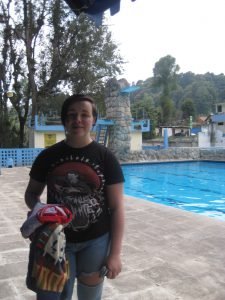
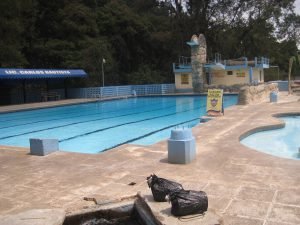
We went by the house were we lived for a year in 2006 and ran into the son of our landlord. We met up with Mario and Chaito, some old friends as school was letting out. They then drove us down to Agua Tibia, the spring fed swimming pool at the edge of town. People in San Marcos always complain about Agua Tibia as being too cold but to me the pool is quite pleasant. We swam and dove off the three and five meter platforms. After buying some bread and hanging out in the main plaza, we walked the five or so blocks to the bus station and headed back up to San Lorenzo. It always amazes me how efficient the bus system is in Guatemala. You never have to wait more than 15 minutes and a bus, going exactly where you need to go is available. How these bus drivers make money does not seem logical. Our fare for the 45-minute ride up 2000 vertical feet was only one dollar each. The bus holds about 20 people.
The weather this whole trip has been splendid. It has been warmer than normal and even during the nights it has been pleasant. In times past, staying up here in the Altiplano was a bit grueling as there often is a chill that gets inside your bones. Running water and hot showers are intermittent at best. Heat is often a brick wood stove. But the people persevere. It is an odd paradox that sometimes people with so little enjoy the day more and generally seem happier than those with vast material possessions. For sure, there is a lot of pain and suffering here, mostly caused by the dire poverty, but yesterday, while walking, we ran into an elderly woman, in traditional Mayan garb, about 4 feet tall, with a long grey ponytail and brilliant grey eyes, tending to her sheep. She was sitting by the side of the road, simply enjoying the day. We could have stayed and conversed for a long while and she seemed at peace with the world. The sun was shining. Little kids as they walked by would greet her with respect. Every now and then she would take her 20 foot long whip out and with great control violently smack it on the ground next to one of her sheep who seemed to be wondering too close to the road. It seemed a bit like a scene from the Hobbit Shire in Lord of the Rings. At any moment Gandalf was going to appear on a horse.
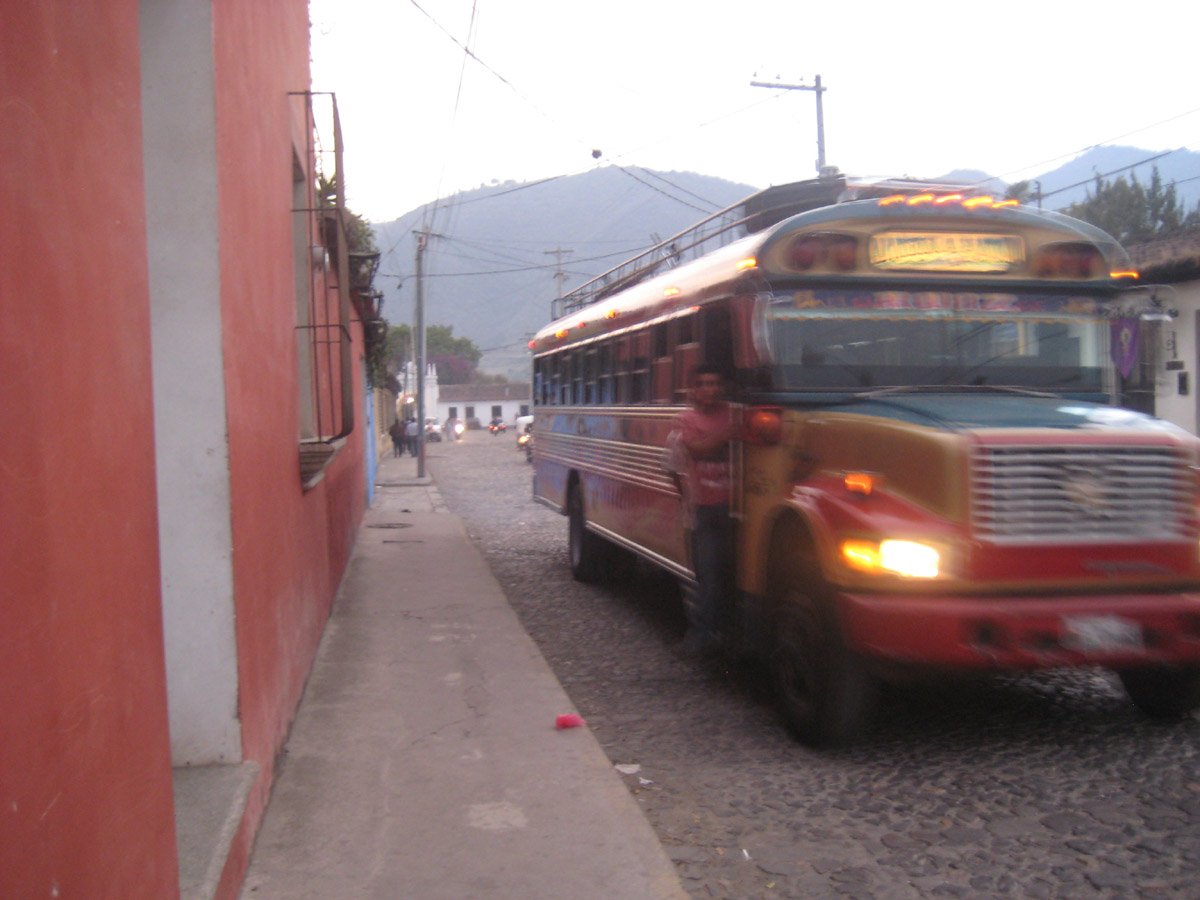
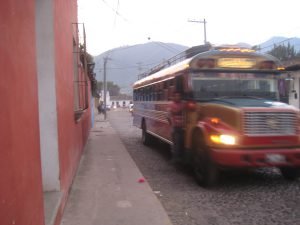
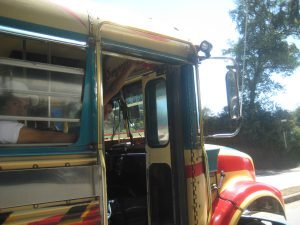
The following day, Andy and I headed back down to San Marcos. We met up for lunch with our good friends, Checha, Paoula and their three beautiful kids. Perhaps the best English speakers in town, they cobble together various jobs as English teachers to make ends meet. On the weekends, Checha sings in various rock and cumbia bands. Earlier, on the street, we ran into one of the shopkeepers who sold school uniforms we had met years back. Unlike my old buddies at the hardware store and pool, he actually recognized me. His shop next to San Carlos school had crumbled in the earthquake. We exchanged pleasant greetings but he did not seem the confidant entrepreneur I remember but a man trying to gather his bearings. We made a trip over to San Pedro via taxi and experienced the market that had not changed a bit. A taxi to San Marcos then a chicken bus back up to San Lorenzo. You have not experienced Guatemala, if you have not been on a chicken bus. They are brightly painted old Blue Bird school buses from the United States. They are often packed with riders. On this particular trip back to San Lorenzo, I spent most of the time standing up crammed in with all the campesinos. The driver seemed to be around 18 years old and had mastered driving the bus like a formula one racer. Hairpin turns at top speed, double shifting, avoiding potholes, passing trucks with skill. I noticed a few bicyclists run off the side of the road as well. Meanwhile his assistant did everything from collecting fares, to climbing up to the roof to store rider’s packages, to assisting the driver negotiate tight intersections or an oncoming vehicle. Bus driver assistants never get on the bus when it is still. The bus must be going at least 10 miles an hour. While shouting out the bus’s destination, they will run parallel to the bus and at the last minute grab on to the railing and board. Often they will disappear and ride on the back ladder and make their way in through the back emergency exit. It takes a remarkable athleticism to be a bus driver assistant.
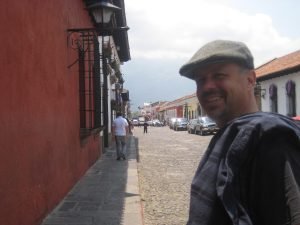
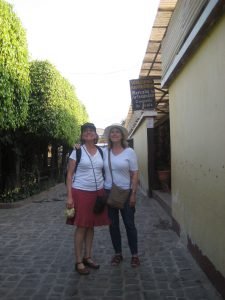
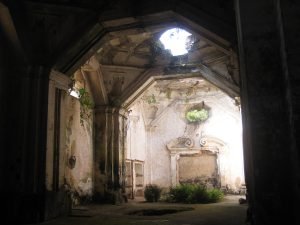
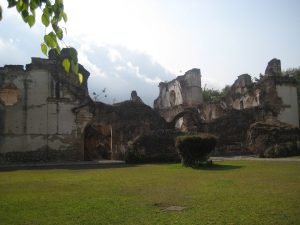
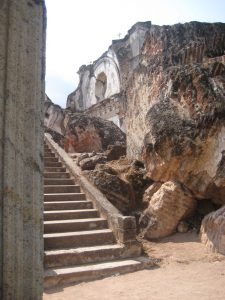
The last few days we spent in Antigua. A bit touristy for sure, but beautiful and full of fond memories. Hot showers, amazing meals, very cool old ruins. One night we walked by THE BLACK CAT Antigua, once a very happening hostel, restaurant, bar establishment. It had changed ownership and right a way I could tell it was not the same place. They did a remodel job that was a bad idea. While I tried to figure out the situation they tried to coerce us in, but we knew better and continued on our way. The place was pretty empty. Word of mouth still travels very fast. It looks like the real BLACK CAT is now in XELA.