“So imagine the Zarabanda, the Congo god of iron – the cutting edge, if you will – traveled on a slave ship with his magic, his mambo, and his machete as soon as the New World was open for business. Then he went back through Havana, across the ocean again, where he got all of Spain dancing, then covertly crept upward through Europe – through the servant’s entrance, of course – and became part of what we now call classical music. In the process, his name was frenchified, he lost his drum and his voice, and his tempo slowed way down. All that remained was the distillation of his dance onto the lute and the guitar, with only the barest trace of the original flavor remaining. Today we call that process going mainstream.”
Ned Sublette Cuba and its Music – From the First Drums to the Mambo (2004)
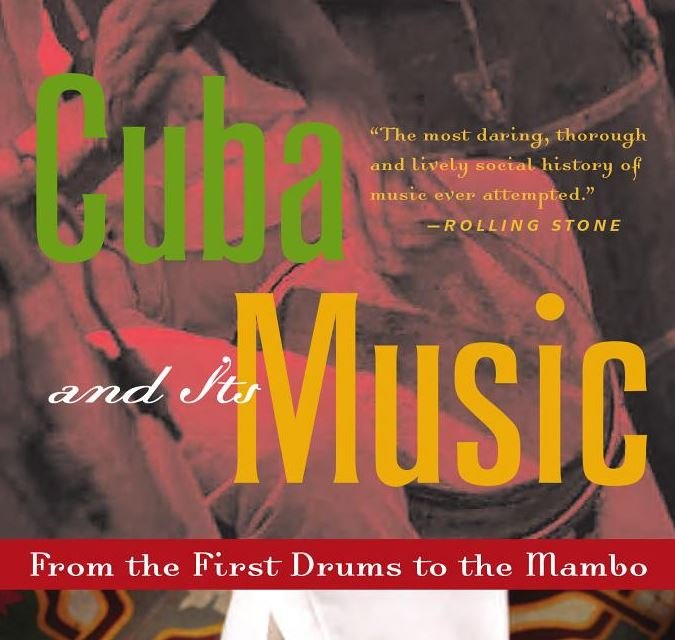
In December, my brother-in-law, Ted “Banjo” Kuster gave me Cuba and Its Music: From the First Drums to the Mambo by Ned Sublette. It is five hundred and eighty pages long and I thought that it would take me until the following December to finish the book, but it was a page turner, at least for any musician who plays American music. In 1998 I wrote a book called Arranging for Salsa Bands – The Doctor Big Ears Essay were I stated – “Let us look deeply into music and explain why things are the way they are.” Ned Sublette goes very deep.
There are many fascinating ideas in the book. One of the main ideas is that African music has had a much larger effect on Western classical music than we realize as the quote above illustrates. The Zarabanda is the grandmother as the Sarabande which composers like J.S. Bach used in pieces like his Bach Cello Suites. And as has been duly noted in many books, the influence of Cuban music on North American music is often ignored and unacknowledged.
The Elephant in the Room – Ned Sublette on the Spectrum of American Music
“If you ever heard an America sax player fail to lock in while jamming with a salsa band, or heard a Cuban band take on a bluesy jazz tune that doesn’t feel right, you know for all that Afro Cuban and African American music might have in common, they’re also very different than each other.
Why? Because essential elements of these two musics came from different parts of Africa, entering the New World by different routes, at different times, into different structured societies.
Ned Sublette Cuba and its Music – From the First Drums to the Mambo (2004)
Here Sublette points out how the differences between the Muslim influenced sub-Saharan Africa as opposed to the forests of the Congo. It is the thesis of the book and he convincingly states the case. This concept alone is worth the price of the book.
Ninth Voluntary Infantry Immune Band from New Orleans
During the time of the Spanish-American war, 1898, the US Army sent a band from New Orleans to Cuba. At the time they thought that black people were immune to yellow fever. Unfortunately they were not. Just imagine the mind set of the military. “Let’s get those jammin’ horn players from New Orleans and send them into war in Cuba. They will do anything!” Anyway, the Ninth Voluntary Infantry Immune Band from New Orleans went down to Cuba for about a year.
“There is no documentation of the Immune Band having performed in Cuba, and it is impossible to say whether their stay in Cuba affected the course of New Orleans music or not. But if a band of the best horn players could stay in Cuba for nine months without absorbing something, at a time when the oquestas typicas were all the rage in Cuba, they would be unlike any musicians this writer has ever known.
Ned Sublette Cuba and its Music – From the First Drums to the Mambo (2004)
As in many places in the book, the scenes seem almost like historical fiction. It would have been fun to hear this band and if they make a movie, just think of coveted gig of being the costume designer for this epic Hollywood blockbuster! Sublette, of course, points out that Havana and New Orleans were were like cousins both being important and vibrant port towns. Wild and crazy places. The Immune Band was just one of many cultural exchanges.
Puerto Rican’s in New York – The Jones Act
The 1917 Jones Act gave Puerto Ricans U.S citizenship. This enable Uncle Sam to fortify the army for the nastiness of World War I. But the Jones Act would also change the cultural and musical landscape in New York in very interesting ways. Most folks just think of West Side Story but of course much more was going on in the art and music worlds.
Any history of jazz that doesn’t mention Puerto Ricans, is leaving something out.
Ned Sublette Cuba and its Music – From the First Drums to the Mambo (2004)
Modernism
Then Sublette presents this heavy concept about modernism that probably makes many academics roll their eyes, but which is an interesting perspective. They did not teach this point of view, in terms of African influence of European music when I was in school, that is certain. Part of the concept has to do with the looting and display of African art around 1900, and that this art was being influential to the abstract artists in Europe such as Picasso and his “Africa period,” but it also has to do with the empowerment of black artists no longer in Africa.
It would later become academic common practice to speak of modernism as being a move toward abstraction and stylization and away from representation and realism, it could perhaps be better explained as the consequence of the liberation of black creativity – which to many white people was an abstract concept.
Ned Sublette Cuba and its Music – From the First Drums to the Mambo (2004)
Conclusion
These are all the quotes I will pull from Ned Sublette Cuba and its Music – From the First Drums to the Mambo (2004). There are many more but at this point you’ll just have to buy the book. The book finishes with a few sections about the Mambo and explores briefly the beginning of television, Desi Arnaz and Perez Prado. It is curious to think that Prado and his dissonant, in your face music, was banned from writing in Cuba and had to go off to Mexico where he eventually became an international sensation. There is mention of many Mexican movies that feature his music that I am really interested in checking out. Prado’s music introduced an adventurous dissonance, resolutions to a dominant 7 #11 b9 chord for example, that now we associate with Mambo, but it was very disturbing for many. I have a feeling that this adventurousness then helped propel some of the more interesting work of later “salsa” artists, like Eddie and Charlie Palmeri, Willie Rosario, Ray Barreto and many of the Fania record label.
This era, from about 1970 to 1990, when the urban music of the Harlem Renaissance known as “be-bop,” a music that signaled the end of jazz as dance music, a harmonically and rhythmically rich music that was pushing the status quo, completely fused with the Cuban son and other rhythms in such a way that made both musics even more vital – and people danced. That is not in the book but is my thesis, and I am standing by it!
If you are interested in actually writing for Latin music groups and want to explore more some of the basics of clave, orchestration and arranging, I would seriously recommend the book below. I reread it last week, and I still think it fills a void in the published material in this field. Below is a link to the first chapter which is pretty silly but actually very important. A lot of people from France seem to be buying it.
THE ART OF CUING A SALSA BAND – THE SPONTANEOUS ARRANGER

Feel free to comment on any of the quotes above with the discussion below.